A good idea should not disappear because the right people were not in the room.
Three of us were in a discussion, a designer, a PM and another product person. One of us shared a genuinely good idea. It got some feedback, and everyone agreed it needed more discussion. The PM said stakeholders had to weigh in on feasibility and direction, but getting them together was hard. A month later it still had not moved, and it eventually went nowhere.
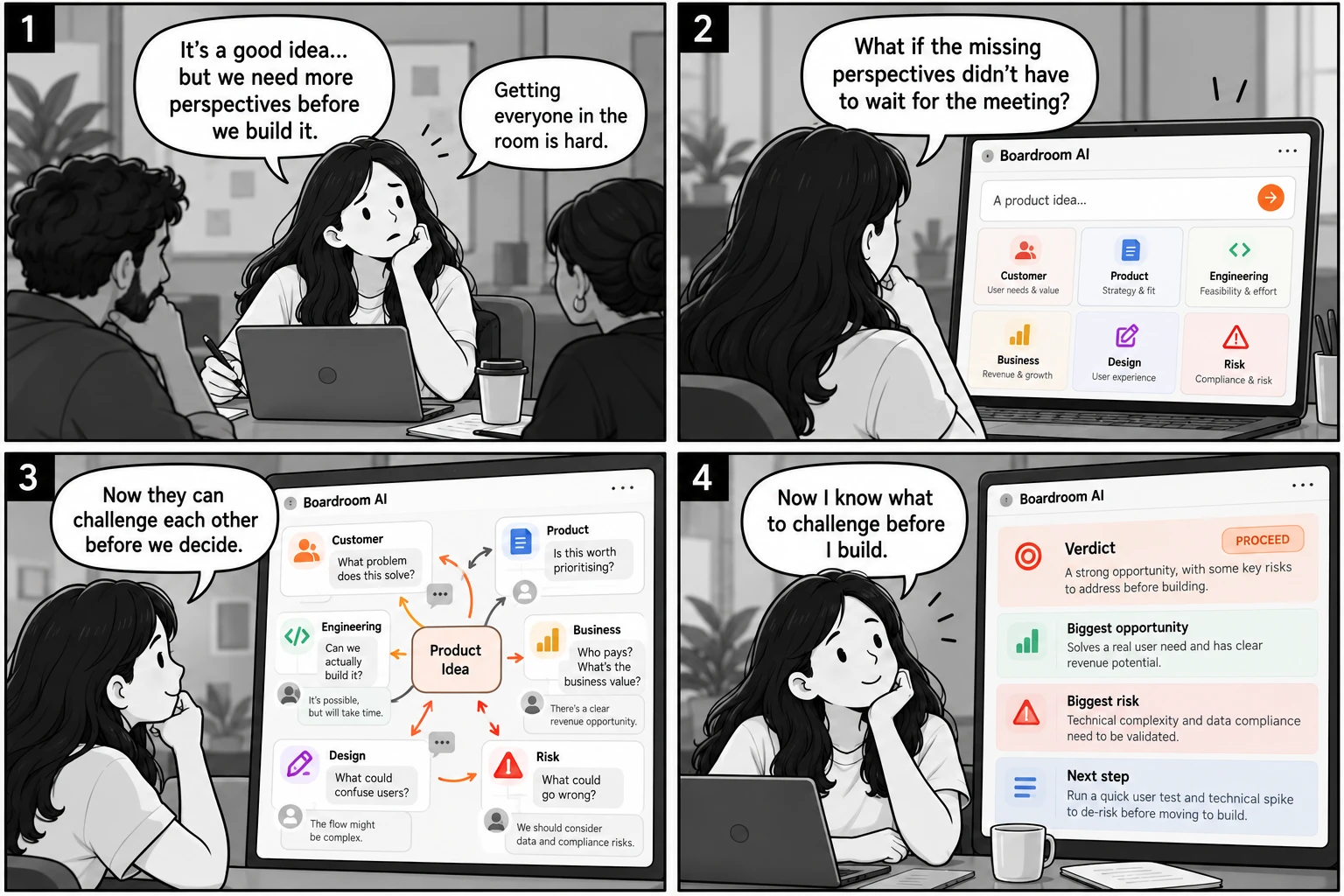
The problem was not a missing process. The right perspectives were hard to bring together while the idea was still flexible. This was one observed moment, not a study, and it gave me a hypothesis worth prototyping.
Why do some ideas move forward before their weakest assumptions have been challenged?
So I traced the path an idea usually takes. Pick a problem to see where it bites.
What if the missing perspectives did not have to wait for the meeting?
That left one question, how to get more perspectives in front of an idea early. I compared six ways. The first five each solve part of it.
I was not trying to replace the boardroom with AI. I was trying to give the boardroom more perspectives before it made a decision.
Six perspectives. Six different questions.
Next, who sits at the table.
Six lenses, not six job titles. More roles started to overlap, so I kept only the six that ask fundamentally different questions.
Six personas did not create a boardroom.
Then the first version failed. It felt like six separate ChatGPT responses. Flip between the two.
Idea in. Six answers out. Nobody reads anybody else.
Six first reactions, one argument, one verdict.
How the room moved
What I decided
I had to define how the AI behaves, not just who it is. Persona design became behaviour design.
Eight rules written into every seat
A real exchange from the recorded demo
Enough explanation. Watch the room work.
So I built it and recorded it running. The verdict, the scores and the follow up questions are all in here.
The challenge was not getting AI to generate opinions.
It was designing constraints that make those opinions useful to a human decision maker.
The early impact was not changing the decision. It was changing the conversation before the decision.
Early validation
I tested the concept with a small group. People did not want more AI generated content. They wanted AI to structure their thinking and surface what they had not considered. This was directional feedback, not a usability study.
What it demonstrates
- Product concept
- AI behaviour design
- Interaction design
- Prompt architecture
Not proven yet
- Product market fit
- Real business impact
- Large scale adoption
- Decision accuracy
My role
- Product
- Problem framing, product concept, user flow and interaction model.
- AI behaviour
- Six perspective definitions, behaviour rules and prompts, disagreement logic.
- Design
- UI and visual system, interaction states and motion, information hierarchy.
With AI products, the interface is only part of the design. The behaviour you design underneath it is the product.